
The Virgin Mary: who she is and why Catholics honor her
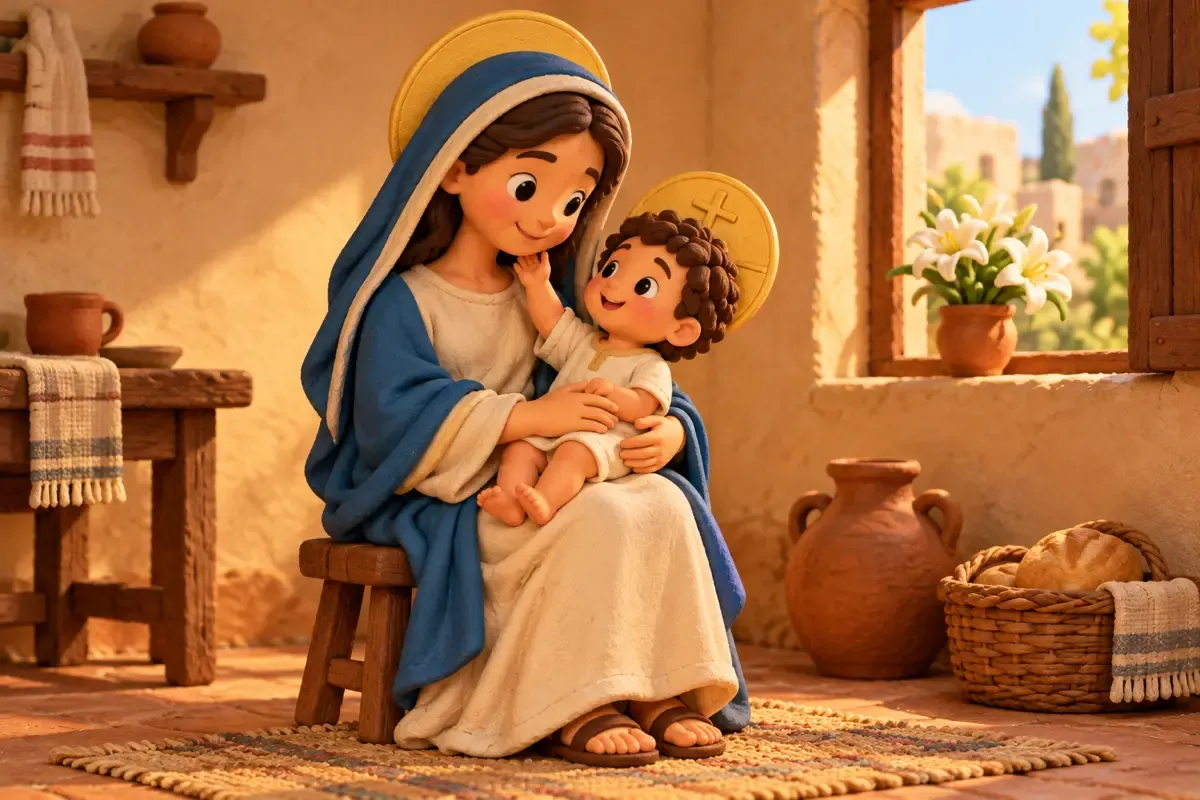
The Virgin Mary is the mother of Jesus. She was a young Jewish woman from Nazareth whom God chose to be the mother of his Son. When the angel Gabriel told her she would be the mother of the Savior, she said yes. That is why the Church calls her the Mother of God, and because Jesus gave her to us from the cross, she is our mother too. Catholics honor her above every other creature, but they worship God alone.
Who is the Virgin Mary?
Mary lived in Nazareth, in Galilee, and was betrothed to Joseph, a carpenter. An ancient tradition says her parents were Joachim and Anne. The angel Gabriel came to tell her that, by the power of the Holy Spirit, she would be the mother of Jesus, and she accepted in faith (Luke 1:26-38). We call this the Annunciation.
Then she visited her cousin Elizabeth, who called her blessed among women (Luke 1:42). She gave birth to Jesus in Bethlehem and raised him with Joseph in Nazareth. At the wedding at Cana she asked Jesus for his first miracle (John 2:1-11). She stood at the foot of the cross, where Jesus gave her as mother to the beloved disciple (John 19:25-27), and she prayed with the apostles as they waited for the Holy Spirit (Acts 1:14).
How old was Mary when she had Jesus?
The Gospels don’t say. From the customs of the time, when Jewish girls were betrothed very young, and from what tradition tells, Mary was most likely very young, probably in her teens, when the angel came to her and when Jesus was born. What the Gospel does tell us is that, young as she was, she answered with enormous faith.
Did Mary have other children?
No. The Church teaches that Mary was always a virgin, as the Marian dogmas below explain. The brothers of Jesus the Gospels mention (Mark 6:3) are close relatives: of two of them, James and Joseph, the Gospel itself says they were sons of another Mary (Matthew 27:56).
Why do Catholics honor Mary?
Because God honored her first: he chose her and filled her with grace to be the mother of his Son. Jesus kept the commandment to honor his mother, and from the cross he gave her to all of us as our mother. In the Magnificat, Mary herself says that all generations will call her blessed (Luke 1:48). And Mary never keeps the attention for herself: she always leads us to her Son, as at Cana, when she told the servants to do whatever he told them (John 2:5).
Honoring is not worshiping. Worship belongs to God alone: the Father, the Son and the Holy Spirit. We venerate Mary and the saints, which means we honor them and ask them to pray for us, the way we ask a friend or a grandmother to pray for us. We honor Mary above every saint, because she is the Mother of God, but that honor is different in kind from worship. When we pray before a picture or statue of Our Lady, we don’t worship the image: it helps us think of her.
The four Marian dogmas
A dogma is a truth God has revealed that the Church teaches as part of the faith. There are four about Mary, and at heart all of them are about Jesus.
Mother of God
Jesus is one Person, true God and true man. Since Mary is the mother of Jesus, she is truly the Mother of God. The Council of Ephesus proclaimed it in the year 431, with the Greek word Theotokos. It does not mean Mary existed before God, but that the child born of her is the eternal Son of God.
Ever virgin
Jesus was conceived by the power of the Holy Spirit, without a human father, and Mary remained a virgin all her life: before, during and after the birth of Jesus. The brothers of Jesus the Gospels mention are close relatives, as the word was used at the time.
The Immaculate Conception
From the first moment of her life, in her mother’s womb, Mary was kept free from original sin, and she never committed any sin. It was God’s gift through the merits of Jesus, who saved her in advance. Pope Pius IX defined it on December 8, 1854. Many people confuse it with the conception of Jesus, but it is about the conception of Mary.
The Assumption
When the course of her earthly life was finished, Mary was taken up body and soul into heaven. Pope Pius XII defined it on November 1, 1950. It is a foretaste of what we hope for: that one day we too will rise with Jesus.
The feasts of the Virgin Mary
All through the liturgical year, the Church celebrates Mary with special love. These are her main feasts for the whole Church:
January 1: Mary, the Holy Mother of God
A solemnity. The year begins with Mary.
March 25: the Annunciation of the Lord
A solemnity, nine months before Christmas: Mary’s yes, and the day the Son of God became man in her womb. When it falls in Holy Week or Easter week, it is kept on the Monday after the Second Sunday of Easter.
May 31: the Visitation
A feast. Mary visits her cousin Elizabeth.
August 15: the Assumption
A solemnity. Mary is taken up body and soul into heaven.
September 8: the Nativity of the Blessed Virgin Mary
A feast. Mary’s birthday.
December 8: the Immaculate Conception
A solemnity, in the middle of Advent. Mary, free from sin from the first moment. When December 8 is a Sunday, it is kept on the 9th.
Each people also honors Our Lady under its own title, one that recalls a place or a story: Guadalupe in Mexico, the Pillar in Spain, Charity of El Cobre in Cuba, Mount Carmel in Chile. It is always the same Mary, the mother of Jesus. These four have a feast lesson in Rosal, free for every family:

Praying with Mary
The Hail Mary joins the greetings of the angel Gabriel and of Elizabeth with the Church’s request that Mary pray for us. The Angelus recalls the Annunciation three times a day. And the Memorare, which many people pray in hard moments, reminds her that no one who has turned to her has been left without help.
As a family
Choose a spot at home for a picture of Our Lady, even a small holy card, and put a flower by it now and then. At bedtime, pray a Hail Mary together for someone who needs it, and let the children choose who.
To read more, the Catechism of the Catholic Church, paragraphs 466, 484, 487, 488, 490, 491, 492, 493, 494, 495, 499, 500, 509, 963, 966, 967, 969, 970, 971, 1172, 2676, 2677.
This topic in Rosal
In the app, these lessons teach this topic:
- “Chosen and full of grace”Unit 6: Mary and the Incarnation. Taught by Saint Bernadette of Lourdes.
- “Mary, Mother of God and our mother”Unit 6: Mary and the Incarnation. Taught by Saint Juan Diego.
- “The Annunciation: Mary says yes”Unit 6: Mary and the Incarnation. Taught by Saint Luke.
- “Blessed are you among women”Unit 6: Mary and the Incarnation. Taught by Saint Elizabeth.
Every lesson starts with a saint’s story and comes with two or three questions that give the Catechism paragraph, one small thing to do at home, and a version for children 6 to 10. Units 2 to 6 are part of Patron. Unit 1 and all 20 feast lessons are free.
More of what we believe
- The Apostles’ Creed (Catholic): full text and what it means
- What is faith? What it means to believe in God
- Books of the Bible in order: how many, how they are grouped
- What is the Holy Trinity? Three Persons, one God, explained
- Who is the Holy Spirit? Gifts, fruits and what he does
- What is Confirmation? Catholic meaning, age and gifts
- What is OCIA? How adults become Catholic (OCIA vs RCIA)
- Who is my guardian angel? What guardian angels are and do
- What is original sin? Catholic teaching, simply explained
- The catechism, explained for families