
What is original sin? Catholic teaching, simply explained
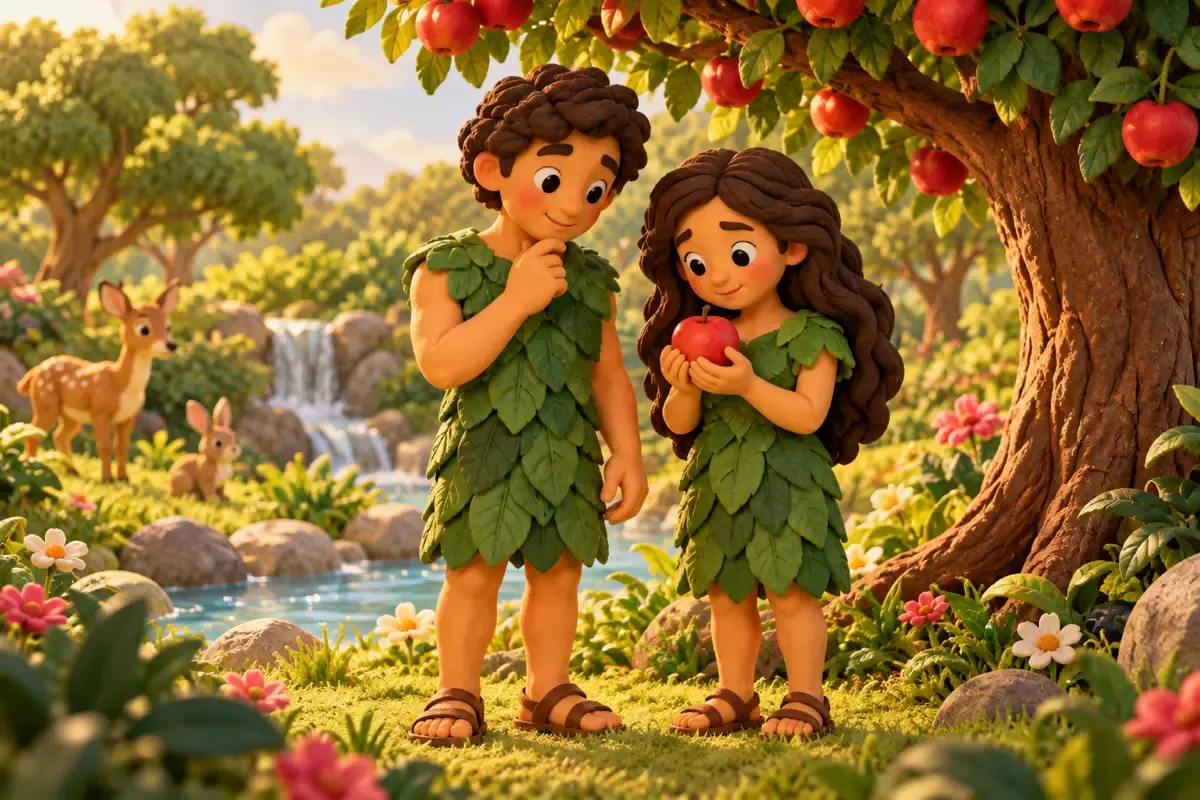
Original sin is the first sin of humanity, the sin of Adam and Eve, and also the state in which all of us are born because of it. Adam and Eve disobeyed God and lost the holiness and friendship with him that God meant to give all his children. We did not commit that sin, but we are born without that holiness and with a wounded nature, inclined to evil. Baptism takes original sin away and gives us God’s life. And God did not abandon us: from the very beginning he promised a Savior.
What was the original sin?
The Bible tells it in chapter 3 of Genesis. God had created the man and the woman out of love, as his friends, in a garden full of life, and he asked them not to eat from the tree of the knowledge of good and evil. Tempted by the devil, who promised them they would be like God, they stopped trusting God and disobeyed him. The heart of the sin was not a piece of fruit: it was preferring themselves to God, wanting to be like God, but without God.
Genesis tells it in the language of images, but the Church teaches that it speaks of a real event, at the beginning of human history. And by the way, the Bible never says the fruit was an apple.
What is original sin?
The word has two meanings: it is the sin Adam and Eve committed, and it is the state in which all their descendants are born. That state is not a personal fault of ours: original sin is contracted, not committed. It is the lack of the holiness and justice God meant to give us from the beginning. That is why our nature is wounded: doing good is hard for us, we suffer and die, and we feel an inclination to evil that the Church calls concupiscence.
How it passes to everyone is a mystery we don’t fully understand. Saint Paul explains it by comparing it with Jesus: as sin came into the world through one man, grace comes to us through Jesus, and far more abundantly (Romans 5:12-21).
How is original sin taken away?
Through Baptism. When we are baptized, God takes away original sin (and every personal sin, if the one baptized is older) and gives us grace, his own life: he makes us his children. That is why the Church baptizes babies too. What remains are the wounds, like the inclination to evil, which are not sins: they are the struggle of a lifetime, in which God helps us with his grace, prayer and the sacraments, above all confession.
God did not abandon us
Right after the sin, God made a promise: the offspring of the woman would overcome evil (Genesis 3:15). Christians see in it the first announcement of the Savior, Jesus, the new Adam, and of his mother Mary, the new Eve. God permitted evil because he can bring a greater good out of it: as Saint Paul says, grace proved far greater than sin (Romans 5:20).
Why was Mary conceived without original sin?
Because she was to be the mother of the Son of God. By a unique gift, from the first moment of her life Mary was kept free from original sin, through the merits of Jesus. This is the Immaculate Conception, which the Church celebrates on December 8. It does not mean Mary had no need of a Savior: Jesus saved her in a more perfect way, before sin could touch her.
As a family
Read chapter 3 of Genesis together and ask the children what Adam and Eve did after they disobeyed (they hid and passed the blame) and what God did (he looked for them, asked where they were, and promised a Savior). Then talk about what we do when we get things wrong, and what God does with us.
To read more, the Catechism of the Catholic Church, paragraphs 385, 386, 389, 390, 396, 397, 398, 399, 400, 402, 403, 404, 405, 407, 409, 410, 411, 412, 416, 417, 418, 419, 491, 1250, 1263, 1264.
This topic in Rosal
In the app, these lessons teach this topic:
- “When we say no to God”Unit 4: The Fall, and God’s promise. Taught by Saint Óscar Romero.
- “Wounded, not abandoned”Unit 4: The Fall, and God’s promise. Taught by Saint Ignatius of Loyola.
Every lesson starts with a saint’s story and comes with two or three questions that give the Catechism paragraph, one small thing to do at home, and a version for children 6 to 10. Units 2 to 6 are part of Patron. Unit 1 and all 20 feast lessons are free.
More of what we believe
- The Apostles’ Creed (Catholic): full text and what it means
- What is faith? What it means to believe in God
- Books of the Bible in order: how many, how they are grouped
- What is the Holy Trinity? Three Persons, one God, explained
- Who is the Holy Spirit? Gifts, fruits and what he does
- The Virgin Mary: who she is and why Catholics honor her
- What is Confirmation? Catholic meaning, age and gifts
- What is OCIA? How adults become Catholic (OCIA vs RCIA)
- Who is my guardian angel? What guardian angels are and do
- The catechism, explained for families