
What is Confirmation? Catholic meaning, age and gifts
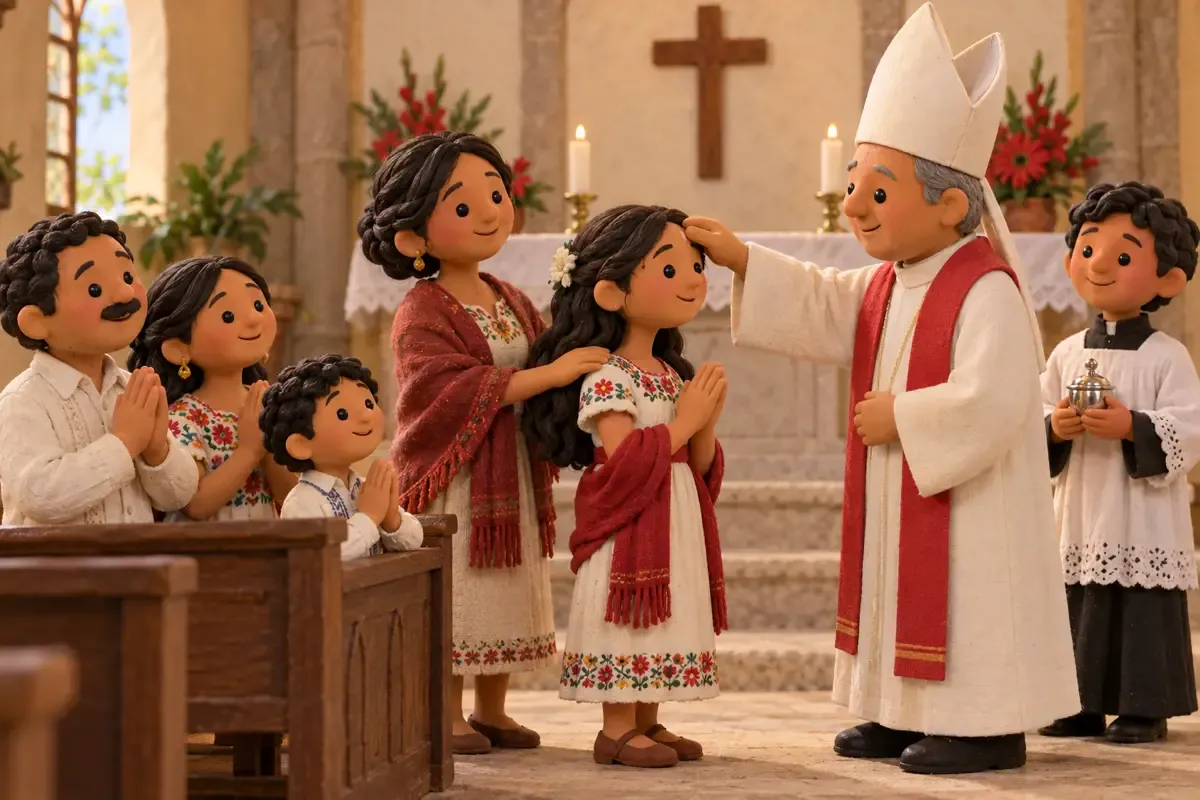
Confirmation is one of the seven sacraments. With Baptism and the Eucharist, it makes up the sacraments of Christian initiation. In it the Holy Spirit, whom we already received in Baptism, is poured out on us with new strength, as on the apostles at Pentecost, so that we can live the faith and bear witness to Jesus. It is received only once, and it is usually celebrated by the bishop, who anoints the forehead with sacred chrism.
What is Confirmation?
Its name means to strengthen or make firm: Confirmation completes the grace of Baptism. Every baptized person not yet confirmed can and should receive it, because without it Christian initiation is incomplete. The Eastern Churches call it Chrismation, after the chrism used to anoint.
Its roots are in the Bible. The prophets foretold that the Spirit of the Lord would rest on the Messiah (Isaiah 11:2), and he came down on Jesus at his Baptism. Jesus promised the Spirit to his disciples and poured him out on them at Pentecost (Acts 2:1-4). Afterwards, the apostles laid hands on the newly baptized so that they would receive the Holy Spirit (Acts 8:14-17).
What are the signs of Confirmation?
It is usually celebrated during Mass. Those being confirmed renew the promises of their Baptism and profess the faith. Then come its two great signs:
The laying on of hands
The bishop stretches out his hands over those being confirmed and asks God to send them the Holy Spirit with his seven gifts, as the apostles did.
The anointing with sacred chrism
Each one comes forward with their sponsor, who places a hand on their shoulder. The bishop anoints their forehead with chrism, tracing the Sign of the Cross, as he says the words of the sacrament, which speak of the seal of the gift of the Holy Spirit. It ends with the sign of peace.
Sacred chrism is perfumed olive oil that the bishop consecrates each year at the Chrism Mass, around Holy Thursday. Oil is a sign of strength, joy and belonging: whoever is anointed is marked as belonging to Christ, whose name means the Anointed One.
What do we receive in Confirmation?
We receive the Holy Spirit in fullness, as the apostles did at Pentecost. The Church teaches that Confirmation unites us more firmly to Jesus, roots us more deeply as children of God, increases the gifts of the Holy Spirit in us, binds us more closely to the Church, and gives us a special strength to defend the faith and bear witness to Christ in word and deed.
Like Baptism, it marks the soul with a seal that can never be erased, called a character. That is why it is received only once in a lifetime.

Who confirms?
In the Latin Church, the ordinary minister of Confirmation is the bishop, a successor of the apostles: this shows that the newly confirmed are bound to the whole Church. The bishop may ask a priest to confirm, and in danger of death any priest may do so. In the Eastern Churches, the priest who baptizes confirms straight away, with chrism consecrated by the bishop.
At what age is Confirmation received?
In the Latin Church it is given from the age of reason, and each bishops’ conference and diocese sets the actual age. So it varies a lot from place to place: some dioceses confirm young children, sometimes before First Communion, and others confirm teenagers. Your parish will tell you the custom where you live. In the Eastern Churches it is received together with Baptism, even as a baby.
The maturity Confirmation asks for is not adult age but maturity of faith. A child in danger of death can receive it at any age. And an adult who was never confirmed can prepare and receive it: just ask at your parish.
Who can be a Confirmation sponsor?
Each person being confirmed has a sponsor, ideally one of their baptismal godparents. The sponsor must be a Catholic who has been confirmed and has received the Eucharist, who lives the faith, who is normally at least sixteen, and who is not the parent of the person being confirmed. Each parish explains its own requirements.
Beforehand, the parish offers a preparation to know Jesus and the Holy Spirit better. You need to be in a state of grace, so people usually make a good confession, and it helps to pray to receive the Holy Spirit with an open heart, like the apostles gathered with Mary before Pentecost. In some countries it is the custom to choose a saint’s name for Confirmation: it isn’t required, but it gives a model and an intercessor.
As a family
If someone in the family is about to be confirmed, pray for them together every night for the month before, asking the Holy Spirit to come. If you are already confirmed, tell your children about your Confirmation, who your sponsor was and what you remember of the day, and find the photos.
To read more, the Catechism of the Catholic Church, paragraphs 1285, 1286, 1288, 1289, 1293, 1297, 1299, 1300, 1302, 1303, 1304, 1306, 1307, 1308, 1309, 1310, 1311, 1312, 1313, 1314.
Is there a lesson in Rosal?
Rosal has no lesson on this topic. The nearest one is:
- “The Holy Spirit, giver of life”Unit 2: God the Father and the Trinity. Taught by Saint John of the Cross.
It teaches who the Holy Spirit is, the one we receive in fullness in this sacrament, and tells the story of Pentecost.
Every lesson starts with a saint’s story and comes with two or three questions that give the Catechism paragraph, one small thing to do at home, and a version for children 6 to 10. Units 2 to 6 are part of Patron. Unit 1 and all 20 feast lessons are free.
More of what we believe
- The Apostles’ Creed (Catholic): full text and what it means
- What is faith? What it means to believe in God
- Books of the Bible in order: how many, how they are grouped
- What is the Holy Trinity? Three Persons, one God, explained
- Who is the Holy Spirit? Gifts, fruits and what he does
- The Virgin Mary: who she is and why Catholics honor her
- What is OCIA? How adults become Catholic (OCIA vs RCIA)
- Who is my guardian angel? What guardian angels are and do
- What is original sin? Catholic teaching, simply explained
- The catechism, explained for families