September 15
Our Lady of Sorrows: what we celebrate on September 15
What do we celebrate on the feast of Our Lady of Sorrows?
On September 15, the day after the Exaltation of the Holy Cross, the Church remembers Our Lady of Sorrows: Mary, who stayed with her Son in love and faith through everything he suffered, and stood beside his cross. It is a memorial in the calendar of the whole Church. In Mexico and Spain, popular devotion also keeps the Viernes de Dolores, the Friday before Palm Sunday.
When is it?
- 2027
- Our Lady of Sorrows: Wednesday, September 15, 2027
- Friday of Sorrows (popular devotion): Friday, March 19, 2027
- 2028
- Our Lady of Sorrows: Friday, September 15, 2028
- Friday of Sorrows (popular devotion): Friday, April 7, 2028
The Friday before Palm Sunday, kept by popular devotion in Mexico and Spain. It is no longer in the General Roman Calendar.
What the Church remembers
This day doesn’t celebrate pain for its own sake, but a mother’s love. When Jesus was a baby, the old man Simeon told Mary that sorrow would pierce her soul like a sword (Luke 2:34-35). And so it was: Mary shared her Son’s sufferings closely, and on Calvary she stayed standing beside the cross, with the beloved disciple (John 19:25-27). Her faith didn’t break even in the darkest hour. That is why the Church sees her as the mother of all who suffer: she knows what it is to weep, and she teaches us to trust God then too.
The seven sorrows of Mary
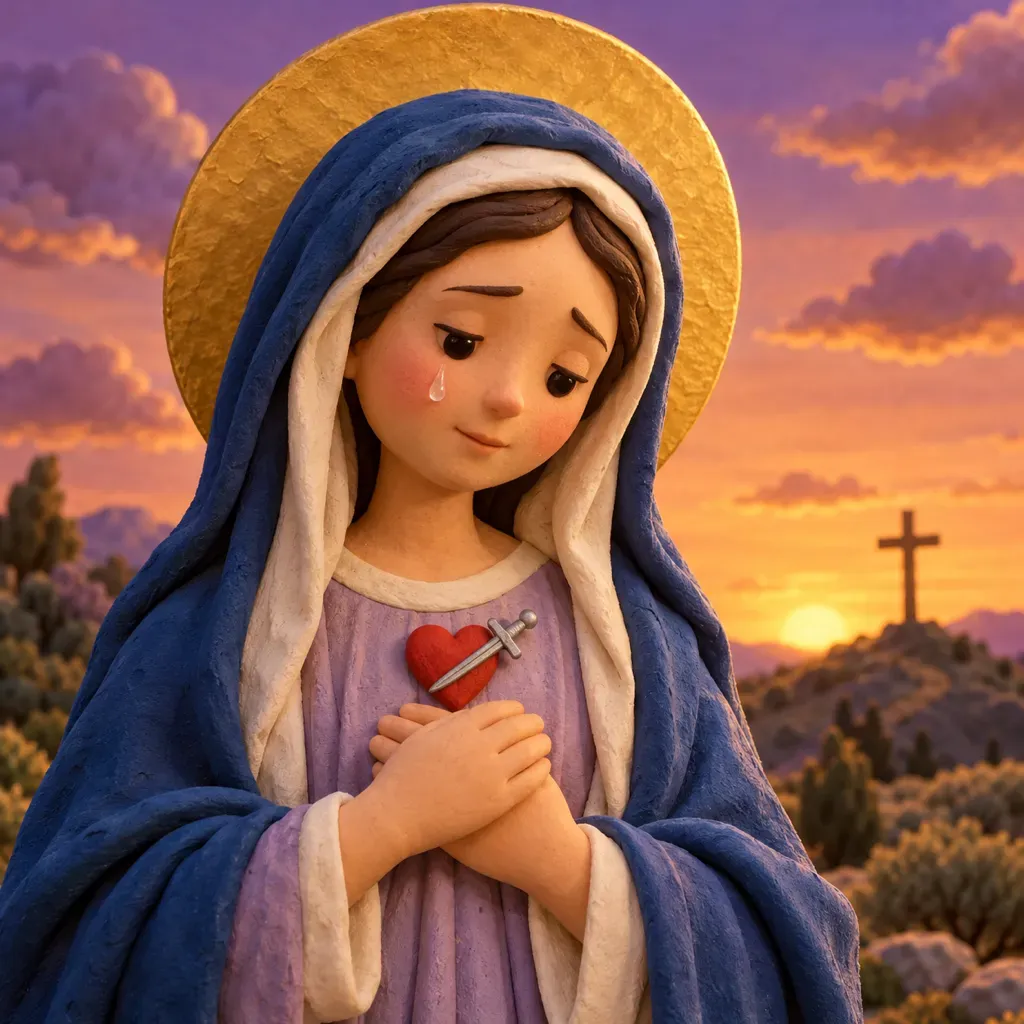
Christian tradition gathers those sufferings into seven sorrows: Simeon’s prophecy (Luke 2:34-35); the flight into Egypt, when the Holy Family had to escape from Herod (Matthew 2:13-15); the three days when the boy Jesus stayed behind in the Temple and his parents searched for him in distress (Luke 2:41-50); meeting Jesus on the way to Calvary, which the Gospels don’t tell but the fourth Station of the Cross remembers; the death of Jesus on the cross (John 19:25-30); the moment his body was taken down from the cross (John 19:38-40); and his burial (John 19:41-42). That is why many images of the Sorrowful Mother show seven small swords over her heart: not to frighten anyone, but to say how much she loved.
A little history
Devotion to Mary’s sorrows grew in the Middle Ages, and the Order of the Servants of Mary, founded in Florence in the 13th century, spread it far and wide. The Stabat Mater, an old hymn that gazes on the Mother at the foot of the cross, also comes from that time. In 1727 Pope Benedict XIII extended to the whole Church a feast of Our Lady’s Sorrows on the Friday before Palm Sunday. In 1814 Pius VII did the same with a second feast, in September, and in 1913 Saint Pius X set it on September 15, next to the feast of the Holy Cross. With the reform of the calendar in 1969, only the celebration of September 15 remained, and the Friday before Palm Sunday left the General Roman Calendar. But the people kept it.
The Viernes de Dolores
The Viernes de Dolores is the Friday before Palm Sunday, one week before Good Friday. In Mexico many families, parishes and neighborhoods set up an altar de Dolores that day: an image of the Sorrowful Mother with candles, flowers and chamomile, little pots of sprouted wheat, a sign of life, and bitter oranges with small paper flags, which recall the bitterness of sorrow and the victory of Easter. In the city of Guanajuato it is one of the best-loved days of the year, and in many places people who stop by to visit the altar are offered an agua fresca. In many places in Spain the first processions go out that day, and from then on the Sorrowful Mother walks behind her Son all through Holy Week.
In Mexico, Spain and Latin America
In Mexico, September 15 has a special echo: the Grito de Independencia of 1810 was given in the early hours of the 16th in the town of Dolores, today Dolores Hidalgo, in Guanajuato, a town named after Our Lady of Sorrows. In Spain and across Latin America, images of the Dolorosa, dressed in black or deep blue and often with tears on her face, go out in the Holy Week processions, and many parishes and towns are dedicated to her. On her day, many people simply pray beside her, thinking of someone who is suffering.
As a family
On September 15, or on the Viernes de Dolores, set a picture of Our Lady at home with a flower and a candle, and pray seven Hail Marys together, one for each of Mary’s sorrows, saying which one before each. Then ask the children: who do we know who is sad or sick, and how can we keep them company, the way Mary kept Jesus company?
To read more, the Catechism of the Catholic Church, paragraphs 149, 529, 618, 964, 971.
Rosal has no lesson for this feast. The nearest is the Holy Week feast lesson, free for every family, which tells how Mary stood at the foot of the cross, taught by Saint John the Apostle, who stood there beside her.