
The Beatitudes
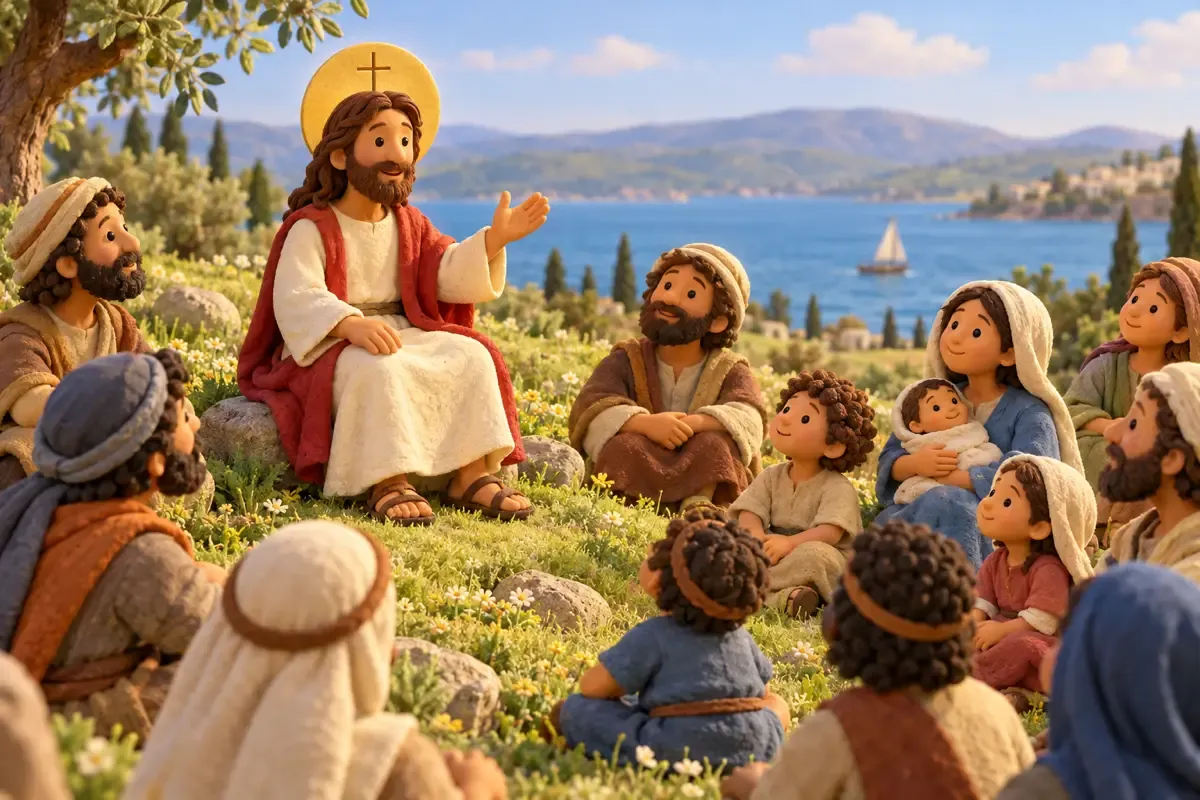
The Beatitudes are the eight sayings with which Jesus begins the Sermon on the Mount, in the Gospel of Matthew (5:3-10). Blessed means happy, in the deepest sense. Jesus calls happy the people nobody else would, the poor, those who mourn, those who are persecuted, and he promises them the kingdom of heaven. They are a portrait of Jesus himself, and the road to the happiness God wants for us. Here they are in the Douay-Rheims translation.
Blessed are the poor in spirit: for theirs is the kingdom of heaven.
Those who know that everything they have comes from God, and who don’t set their hearts on money or things. It is the humility of someone who trusts God.
Blessed are the meek: for they shall possess the land.
People who don’t answer with violence or shouting, and who treat others gently, even when it is hard.
Blessed are they that mourn: for they shall be comforted.
Those who suffer, and those who grieve over evil and sin. God doesn’t leave them alone: he comforts them himself.
Blessed are they that hunger and thirst after justice: for they shall have their fill.
Those who long, the way we long for food and water, to be good and holy, and to see everyone treated fairly.
Blessed are the merciful: for they shall obtain mercy.
Those who forgive and help people in need. God shows the same mercy to them.
Blessed are the clean of heart: for they shall see God.
Those whose hearts are pure and honest, seeking God and looking at others with love.
Blessed are the peacemakers: for they shall be called the children of God.
Those who live in peace and help others make peace. They are like God, which is why they are called his children.
Blessed are they that suffer persecution for justice’ sake: for theirs is the kingdom of heaven.
Those who are mocked or mistreated for doing good and for being faithful to Jesus. He promises them what he promised the poor in spirit: the kingdom of heaven.
Many modern Bibles say “happy” instead of “blessed”, and put those who mourn before the meek. After the eight, Jesus adds a few words for his disciples, for when they are persecuted (Matthew 5:11-12), and Saint Luke gives a shorter version (Luke 6:20-23). The Church reads the Beatitudes at Mass on All Saints’ Day, November 1.
As a family
Choose one beatitude a week and write it on a card for the kitchen. During the week, everyone looks for someone who lives it: a gentle classmate, a neighbor who makes peace. On Sunday, talk about it over lunch.
To read more, the Catechism of the Catholic Church, paragraphs 1716, 1717, 1718.
The feast that goes with this topic
 November 1All Saints, All Souls and Día de Muertos
In the app, the lesson “Made happy, made free” in Unit 4 goes with this topic.
More from the catechism
- The Ten Commandments in order, with their Bible verses
- The seven deadly sins and their virtues
- The seven gifts of the Holy Spirit
- The twelve fruits of the Holy Spirit
- The five precepts of the Church
- The seven sacraments of the Catholic Church, in order
- The corporal and spiritual works of mercy
- The three theological virtues
- The four cardinal virtues
- The parts of the Mass