
The Ten Commandments in order, with their Bible verses
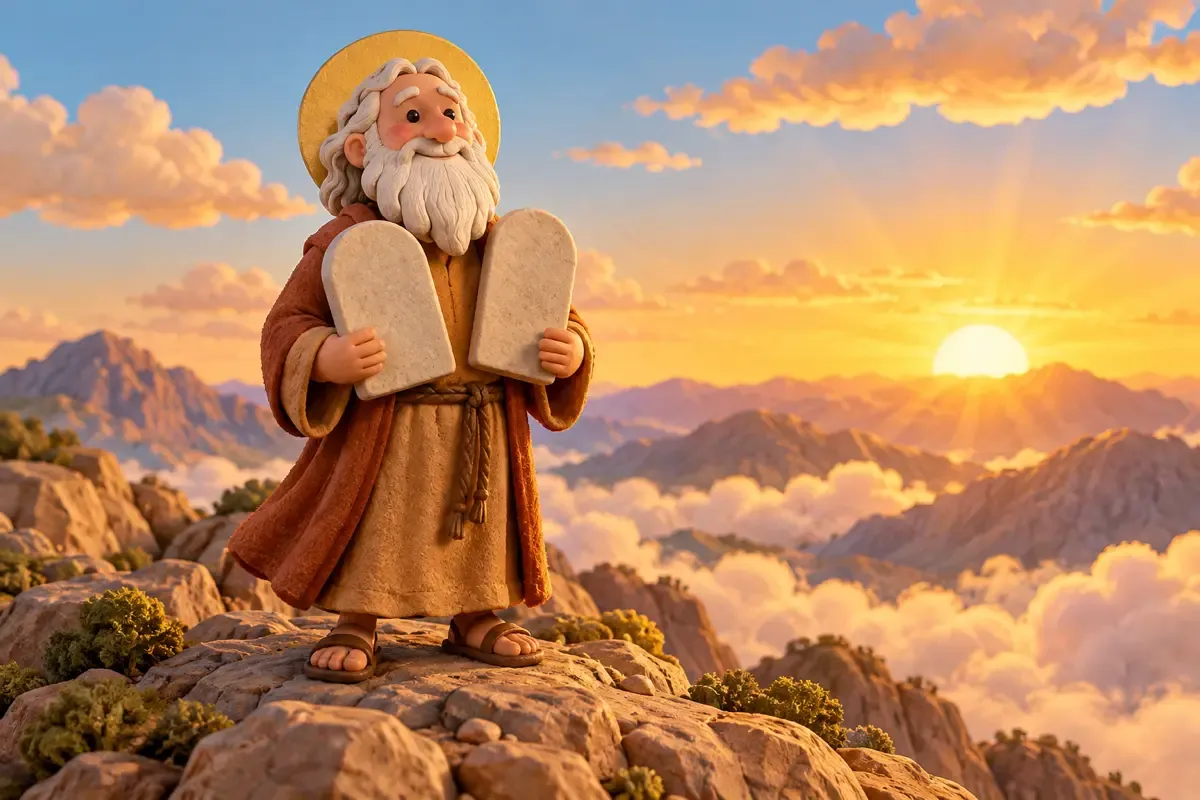
The Ten Commandments are the law God gave Moses on Mount Sinai, written on two tablets of stone (Exodus 20 and Deuteronomy 5). Jesus summed them up in two: love God above all things, and love your neighbor as yourself. The first three are about our love for God, and the other seven about our love for others.
I am the Lord your God: you shall not have strange gods before me.
God comes first, before money, success or anything else. We live it by praying, by trusting him, and by not looking for help in superstition.
You shall not take the name of the Lord your God in vain.
The names of God, Our Lady and the saints are spoken with respect, never to curse or to swear falsely.
Remember to keep holy the Lord’s Day.
Sunday is the Lord’s Day: we go to Mass and we rest, to spend time with God and with the family.
Honor your father and your mother.
It asks children for respect, love and obedience, and asks parents to care for their children and bring them up. It includes grandparents and everyone who looks after us.
You shall not kill.
It protects every human life, from its beginning to its natural end. It also asks us not to hurt others through violence, hatred or resentment, and to look after our own health.
You shall not commit adultery.
It asks us to live chastity: to respect our bodies and love itself, and to be faithful in marriage.
You shall not steal.
Not taking what belongs to someone else, giving back what isn’t ours, paying what is fair, and sharing with those in need.
You shall not bear false witness against your neighbor.
It asks us to tell the truth, not to spread lies about anyone, and not to tell other people’s faults without need.
You shall not covet your neighbor’s wife.
The sixth commandment guards what we do; the ninth guards the heart, where desires begin.
You shall not covet your neighbor’s goods.
It asks us not to envy what others have, and to be content with what God gives us.
Where are the Ten Commandments in the Bible? (Exodus 20 and Deuteronomy 5)
The Ten Commandments appear twice in the Bible: in the book of Exodus, chapter 20, verses 2 to 17, when God gives them to Moses on Mount Sinai, and in Deuteronomy, chapter 5, verses 6 to 21, when Moses repeats them to the people before they enter the Promised Land. They aren’t numbered there: the short form we learn in catechism class is a summary for memorizing them. The Bible itself says they are ten (Exodus 34:28), and Jesus confirmed them when a young man asked him what he had to do to have eternal life (Matthew 19:16-19).
What is the first commandment?
To love God above all things: God comes first, and we put nothing in his place, not money, not success, not superstition. In the Bible it begins with God introducing himself to his people as the Lord who brought them out of slavery in Egypt (Exodus 20:2-6), and Jesus said that loving God with all your heart is the first and greatest commandment (Matthew 22:37-38).
How many commandments are there?
Ten: that is what the Bible itself calls them (Exodus 34:28; Deuteronomy 10:4). Jesus summed them up in two, love of God and love of neighbor (Matthew 22:37-40). Separate from them are the five precepts of the Church, which help us live the faith at its most basic, such as going to Mass on Sundays.
How did Moses receive the Ten Commandments?
After leaving Egypt, the people of Israel camped at the foot of Mount Sinai. God called Moses to the top and gave him his law, written on two tablets of stone (Exodus 19 and 20; 31:18). When Moses came down and saw the people worshipping a golden calf, he broke the tablets, and God gave them to him again (Exodus 32 and 34). The tablets were kept in the Ark of the Covenant (Deuteronomy 10:5).
The Catholic Church numbers the commandments the way Saint Augustine did. Other Christian churches split the first into two and join the ninth and tenth, which is why lists sometimes don’t match.
As a family
Pick one commandment a week and talk about it at dinner: what it asks, and one way to live it at home. With children, the fourth and the eighth are good places to start.
To read more, the Catechism of the Catholic Church, paragraphs 2052, 2055, 2066.
In the app, the lesson “Moses and the burning bush” in Unit 5 goes with this topic.
More from the catechism
- The seven deadly sins and their virtues
- The seven gifts of the Holy Spirit
- The twelve fruits of the Holy Spirit
- The five precepts of the Church
- The seven sacraments of the Catholic Church, in order
- The Beatitudes
- The corporal and spiritual works of mercy
- The three theological virtues
- The four cardinal virtues
- The parts of the Mass