The Thursday after Trinity Sunday (in many countries, the following Sunday)
Corpus Christi
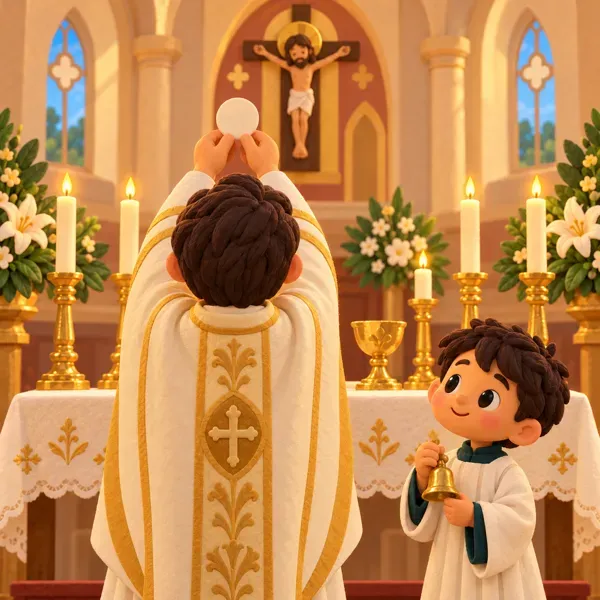
Corpus Christi is Latin for the Body of Christ. The Church keeps it on the Thursday after Trinity Sunday, and in many countries it moves to the following Sunday. It is a feast of thanks for the Eucharist. The Church teaches that at Mass, when the priest says over the bread and wine the words Jesus said at the Last Supper, Jesus himself becomes truly present: his Body and Blood, with his soul and his divinity. This is called the Real Presence. The bread and wine look, smell and taste the same as before, but the Church believes that what they really are has changed.
The saint who teaches today is Thomas Aquinas, an Italian friar of the Dominican order who taught at the University of Paris. In 1264 Pope Urban IV made Corpus Christi a feast for the whole Church. Tradition says that the Pope asked Thomas to write the prayers and hymns for the new feast, and the Church has long sung the hymns Pange lingua and Tantum ergo under his name. Thomas taught that we cannot see the Real Presence with our eyes. We know it by faith, because Jesus himself said it.
On Corpus Christi many parishes take Jesus out of the church walls. After Mass the priest carries the Eucharist through the streets in a monstrance, a golden holder shaped like a little sun, and the procession ends in the church with Benediction, when the Tantum ergo is sung. In many towns of Spain and Latin America the streets are covered with carpets of flowers, petals or colored sawdust, balconies are hung with fabrics, and children dressed for their First Communion scatter petals as Jesus passes by. The Church teaches that Jesus in the Eucharist deserves our adoration, in the Mass and outside it.
Why does the Church celebrate like this? Because at the Last Supper Jesus loved his friends to the end, and he wanted to stay with them. He remains with us in the tabernacle of every Catholic church, where a small lamp burns beside him, and he comes to us in Holy Communion. The next time you walk into a church, look for that little light. In his hymn, Thomas asks that faith make up for what our senses cannot see:
“Let faith make up for what our senses cannot see.”
Bring it home
Make a small carpet of flower petals or colored chalk on your doorstep, then visit a church together. Look for the little light beside the tabernacle and say thank you to Jesus for staying with us.